
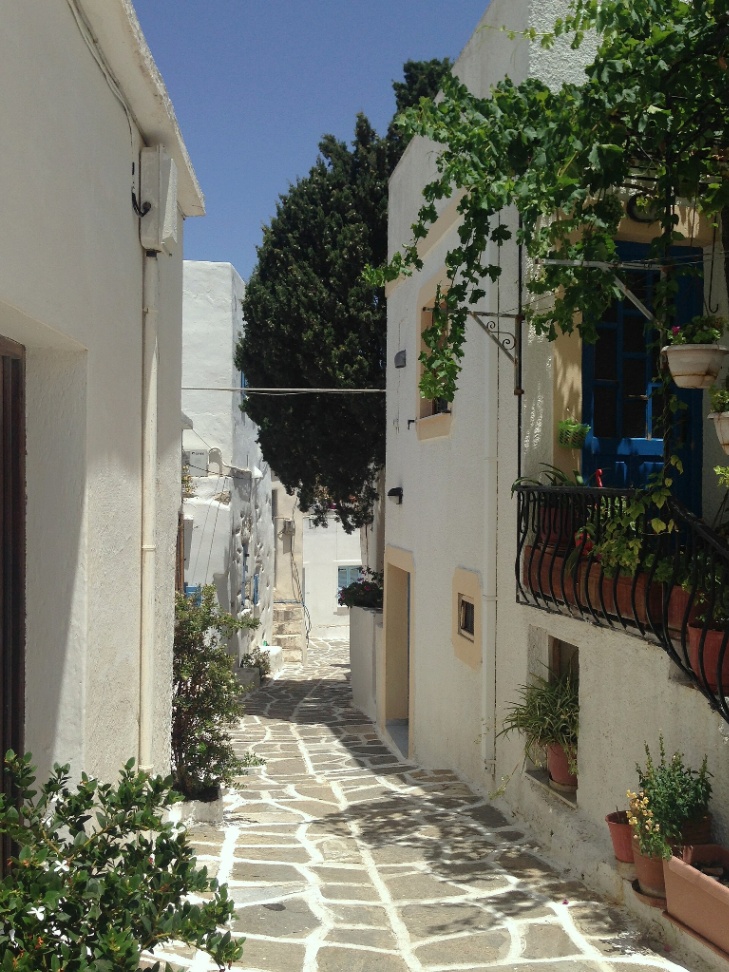
Drive fifteen minutes uphill from either coast of Paros and the island changes completely: the beach bars give way to amphitheatres of terraced hillside, and at the centre sits Lefkes — a marble-paved village that was once the island's capital, built high and hidden to stay out of pirates' sight. Add Prodromos, Marpissa and Kostos, and you have the best half-day drive on Paros. Here's the route.
Lefkes: the old capital
Lefkes earns its reputation the moment you step onto its lanes — actual Parian marble underfoot, polished by three centuries of feet. The village folds down a green hillside around the twin-towered Agia Triada church, whose cream marble came from the island's own quarries. What to do:
- Wander without a map. The village is small enough that lost lasts ten minutes and always ends somewhere photogenic.
- Coffee on the square under the plane tree, or a proper lunch at one of the tavernas with valley-to-sea views from the terrace.
- Look for the windmills on the ridge above, and the tiny folklore museum when it's open.
- Time it right: mornings before the coach tours, or golden hour when the marble glows. Park in the lots at the village entrance — Lefkes itself is pedestrian.
Walk the Byzantine Path
The single best hour on inland Paros: the Byzantine Path, a 1,000-year-old marble-flagged trail, runs 3.5 km gently downhill from Lefkes to Prodromos through olive terraces and drystone country. Wear real shoes, carry water, and do it before 10am in summer. The logistics are the only puzzle — it's one-way with your car parked in Lefkes — solved three ways: walk back up (40 sweaty minutes), have one of your party drive around to meet you, or time the return bus. Two-car groups have it easiest.
Prodromos, Marpissa and Kostos
- Prodromos greets the path's end with a whitewashed fortified entrance arch and lanes that see a tenth of Lefkes's visitors.
- Marpissa, five minutes on, is the sleeping beauty of the east side — windmills, sculpture-dotted squares, and Easter celebrations famous across the Cyclades. From here you're eight minutes from a swim at Logaras or Golden Beach.
- Kostos, back on the mountain road toward Parikia, is the village tourism forgot — one square, one church, two tavernas, entirely itself.
The half-day loop
From Parikia or Naoussa: mountain road to Kostos (coffee) → Lefkes (wander + lunch, or walk the path) → Prodromos → Marpissa → swim at Logaras → harbour dinner in Piso Livadi → return via the coast road. Total driving: under an hour; total day: as long as you let it. This is day 3 of our Paros itinerary, and it's flatly impossible by bus timetable — one of the days that answers do you need a car in Paros? by itself. A compact handles every road here; the mountain bends are also the island's favourite quad run. Pick your ride.
Frequently asked questions
Is Lefkes worth visiting?
It's the best village on Paros and one of the finest in the Cyclades — a genuine old capital, not a curated attraction. An hour minimum; half a day with the walk and lunch.
How do you get to Lefkes?
15–20 minutes by car from Parikia or Naoussa on the paved mountain road; buses run a few times daily in season. Park at the entrance lots and walk in.
How hard is the Byzantine Path walk?
Easy-moderate: 3.5 km, downhill from Lefkes, 60–75 minutes on uneven marble flags. Not push-chair friendly; fine for active kids.
Which other Paros villages are worth a stop?
Marpissa and Prodromos (this route), fishing-village Aliki in the south, and Ambelas for a fish lunch on the northeast coast — all covered in the complete Paros guide.
Cover image: Zde, CC BY-SA 4.0, via Wikimedia Commons.